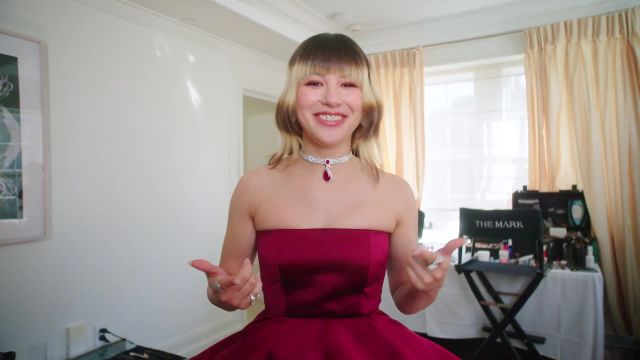
Ahead of the Met Gala, an Up-Close Look at “Costume Art”
Directors of Photography: Michael Lopez, Henry Gill
Editor: Evan Allan
Senior Producer: Bety Dereje
Producer: Rashida Josiah
Associate Producers: Anisa Kennar, Justine Ramirez, Lea Donenberg
Camera Operator: Chanthila Phaophanit
Assistant Camera: Kahdeem Prosper Jefferson, Gordan Wong
Gaffers: Billy Voermann, Mary Kalecinska
Swing: Alex Frischman
Audio: Mariya Chulichkova, Joanna Hunt
Set Designers: Ilana Portney, Dana Keren
Production Assistants: Quinton Johnson, Myles Haywood
Runners: Edie Chesters, Rachel Ademidun
Groomer for Andrew Bolton: Shin Arima
Makeup Artist for Sinéad Burke and Alex Consani: Ai Yokomizo
Hairstylist for Sinéad Burke and Alex Consani: Sonny Molina
Makeup Artist for Misty Copeland: Victor Henao
Hairstylist for Misty Copeland: Nai'vasha Grace
Makeup Artist for Aariana Philip: Meadow Soleil Cloud
Makeup Artist for Gwendoline Christie: Daniel Kolaric
Hairstylist for Gwendoline Christie: Joe Kelly
Hair & Makeup Artist for Aimee Mullins: Stèfan Jemeel
Production Coordinator: Tanía Jones
Production Manager: Kristen Helmick
Senior Production Manager: Venita Singh-Warner
Line Producer: Natasha Soto-Albors
Assistant Editors: Andy Morell, Fynn Lithgow
Senior Motion Graphics Designer: Samuel Fuller
Post Production Coordinator: Holly Frew
Supervising Editor: Kameron Key
Post Production Supervisor: Alexa Deutsch
Entertainment Director: Sergio Kletnoy
Global Talent Casting Directors: Ignacio Murillo, Morgan Senesi
Executive Producer: Rahel Gebreyes
Senior Director, Digital Video: Romy van den Broeke
Senior Director, Programming: Linda Gittleson
VP, Video Programming: Thespena Guatieri
Florist: London Blooming Haus
Photography By Paul Westlake
Images Courtesy of The Metropolitan Museum of Art
Special Thanks: The Metropolitan Museum of Art
Released on 05/01/2026
Fashion is the first thing
we see about each other.
So it's incredibly powerful.
Fashion can tell a story.
At its best,
it expands what the body can be.
There are just so many ways in which the human
body takes form.
How then does that impact
what we layer on top of it?
No longer can we debate
the idea that fashion is art.
Fashion has always been art.
The pressure, ah.
We're in the Costume Center.
For the moment,
we're using it as a way to store our mannequins
and dress some of the pieces for the exhibition.
But these are actually our traditional galleries.
[Interviewer] But not anymore.
Not anymore, yeah.
It's so exciting.
We're now moving upstairs into the lights.
The Met collects many things.
Paintings, sculpture, textiles, arms and armor,
but especially also fashion.
And we want to make sure that it's understood
that fashion is a fantastic form of art.
To do that,
we want to make sure that the galleries devoted
to that would be centrally located.
The Great Hall is one
of the most recognizable interiors in New York City.
Our galleries come directly off of that space.
We sort of started by taking
a deep dive into the museum building itself.
Looking at old drawings,
understanding the way it came together,
but it's actually not one building.
It's 20 something buildings that have grown
and shifted over time.
The title of the show is called Costume Art.
It has two connotations.
One, it references our history.
So before we were founded in 1946
as a curatorial department at the Met,
we were known as the Museum of Costume Art
and it was an independent entity,
but also a statement about
the status of of fashion itself.
I think that when you walk
around the museum,
you see these wonderful examples
of the dress body,
but it's just a representation of the dress body.
I think where fashion has the edge
over art is the fact
that it's about our lived and embodied experience.
So I very much wanted the exhibition to focus on
that distinction between the representation
of the dress body and also fashion
as this living art form in which it expresses very complex
ideas about identity.
I think it's been interesting working
with different curators.
We've done shows in the past where we've collaborated
with specific departments.
We've never done a show before
where we're collaborating
with every single department in the museum,
and Navina was actually the first person I spoke to.
The Met is an amazing place
that can tell global stories
because it has the ingredients,
it has everything at his fingertips.
We have a wonderful painting
from the 18th century
from one of the courts of India, from Hyderabad,
which shows a woman in a very transparent muslin.
It's so light, it's so fine
that the body looks almost nude under it.
In every case,
Andrew has found a response in contemporary
fashion to these pieces
and that's what's making them come alive.
So I wanted to start off the exhibition
with the art historical distinction
between the naked and the nude.
The naked is really about one's lived vulnerability,
whereas the nude is a sort of mediated construction
that's often posed or aestheticized.
In any time and place,
the naked body's never naked.
It's always dressed
in the cultural ideals of a particular moment in time.
And then you go into the main part of the exhibition
and it's separated into two main galleries.
One is focusing on sort of diversity of bodily being
and we start off with a classical body in that section
'cause I wanted to look at
and sort off with a body that has often been valorized.
It's a body that has always been reified,
both in arts and also within fashion.
And then we progressed to a section
called the Abstract Body,
which is in a way the opposite of the classical body
where we have many women's bodies that are contorted
and distorted through undergarments like the corset,
the crinoline, the pannier, and the bustle.
Even though they seem radically opposite
of the natural body,
they're both about achieving an ideal beauty.
So opposite the abstract body,
we focus on something we call the Reclaimed Body.
And the Reclaimed Body mainly feature female designers
who do the opposite.
Who use understructures, padding,
bindings to challenge these normative conventions of beauty.
So it's the opposite of what the abstract body is about.
The Reclaimed Body is sort
of introducing three other body types
and reclaiming these bodies within both art and culture.
With the pregnant body,
the corpulent body,
and the disabled body.
So that's the first half of the exhibition
and the second half,
it's all about universality and commonalities.
Everything we all share.
So skin, the anatomy, blood,
but also our experiences of life
like aging and death, or mortality.
So we have bodily diversity in one gallery
and body universality in the other.
Then we end with some,
I'm calling the Epidermal Body,
which in a way is the largest and most salient organ.
We all have skin,
but all of our skin tones
and textures are very different.
So it brings them together
and in a way ends with a celebration of plurality
and the the pluralistic body.
I think in the past, you know,
in my previous exhibitions,
whenever we talk about diversity,
I've always integrated it within our exhibitions,
but I do think we're particularly now,
I don't think we're at a place
where we normalize diversity.
It has become otherized
and you see it reflected in fashion.
What's special about costume art is
that the question it asks is,
is fashion already art
or does it become art through embodiment?
I have dwarfism,
I have a physical apparent disability.
Fashion has always been incredibly important to me
because it's a vocabulary,
it's an armor
and that's still, I think,
how many people use clothes,
whether or not they make that conscious decision.
So to be able to put that in place in this exhibition
with the explicit inclusion
of different kinds of bodies,
putting them on pedestals,
what it will mean very physically
when people come into this
exhibition is that for the first time
they will look at bodies that maybe
they have overlooked with a sense of awe
and wonder because they are looking up.
I spend my life looking up,
so I'm really intrigued
and curious about what that change will mean
for others within that space.
I think for me,
like the body
obviously means something very specifically
to me as a trans woman.
I think that it has always kind of been a point
of conversation for others,
but I think to reclaim that
and really find what makes me feel beautiful
as an individual and makes me feel
supported and loved,
and able as an individual is quite special.
For me, it means express things
and show the strength that I have in my body.
Show the muscles that I have,
show the ass that I'm hopefully gonna have
on the Met Gala day.
But like all of these different things,
I can't tell you how much it means to me
to be a part of this.
Like, I feel like disability
and disabled people in the world overall
is the most like underrepresented, underserved population.
As we can see,
I have quadriplegia cerebral palsy.
I am visibly disabled and I use a wheelchair.
And so to be recognized in the arts
in this kind of way
and fashion in this way
is so deeply touching and meaningful.
As a performer and as an artist,
my body is my instrument
and I often say that it's my first costume.
Like, the skin I'm in,
in the body that I have as a dancer.
It's what we're working with.
Two of the things I love most in the world,
costume and art,
the way our body can be changed and subverted,
the way our form can alter
and inform our mental state
is something so divine to me.
You know, the show is really focusing on the body
and really focusing on the idea
of one's lived embodied experience.
We felt it was very important
to actually include mannequins based on real men and women,
particularly in the corpulent body
and the disabled body sections.
Andrew had written me
to ask if I would be a mannequin in this show
and the outfit that was made
for me was already gonna be in the show.
It was important to me that it actually
be on my body, especially my body now.
You go into this room
that has about 100 SLR cameras positioned.
And even just thinking about getting
my body made into a mannequin
was an incredibly vulnerable process.
I was in the middle of this thing,
I was sitting right here
and then around me were like thousands of cameras
just scanning me
and taking pictures of me
to make the model and it was really awesome.
I felt like I was in like a 90s futuristic anime.
They sent them off to Italy
where they would be converted
into a 3D scan and then carved.
I always find within exhibitions,
one of the challenges is
how do we sort of bridge the gap
between the art you're looking at,
the artworks you're looking at and the visitors.
So I'd always sort of thought about the idea
of using a mirrored face as a way of diminishing that gap
between the visitor and and and the artwork.
I came across the work of Samar Hejazi,
an extraordinary artist
who had used polished steel faces
and what was so interesting about them is
because they're made outta polished
steel rather than mirror,
there's a depth to them.
It's like your reflection in a wishing well or a pool.
It's not a sort of mirror-mirror idea.
It's slightly distorted
and I think that how we all see ourselves in the mirror
is always slightly distort.
It's never true.
I love and also think the polished faces
are really funny,
which, you know, I'm really glad Andrew's not sitting
beside me because he would probably shake
his shoulders at me.
I really interested to see what people take from it.
It's very interesting.
I love that idea that they chose to do that.
I feel like it speaks to a lot.
They're gonna see themselves reflected in me
and I'm gonna see myself reflected in them.
I think one of the ambitions
for the show is we're not trying to sort
of like reverse a hierarchy
that's always existed within art museums
where fashion's are the bottom rung of the ladder.
It's more about focusing on equitability.
So the idea of equitability between objects,
whether it's art or fashion,
but also an equitability of bodies,
whether it's the classical body or the disabled body.
There is a risk that if you don't honor them in this way,
people moving through the space go
through it passively without noting that it is different.
But also for those who would live in those bodies,
to see their bodies singled out
with respect, grace, admiration,
and with psychological safety at the heart of it,
what can that be a catalyst for?
When you have the opportunity to work with a range
of body types,
you're going to get an incredible range of results.
And I think that's something
that's important about seeing more diversity in in fashion,
you know, and I think about it so connected to,
you know, the way I talk about the importance
of having more diversity in classical dance.
That when you see different body types exploring the same
type of movement,
it's going to look completely different.
It's really amazing for someone like me to be there,
but also like there's a lot of really
amazing women and men,
and everything in between who are a part of it.
And I think that that's really special and really unique,
and I hope that I serve for all of us.
The pressure, ah.
The emphasis on the individual,
what it is that makes us unique,
what it is that makes us different.
It is about seeing those moments,
seeing those pockets
of individuality and highlighting their beauty.
I think it's so important that there is representation
and equity and diversity and and inclusivity.
Again, when the world as it's standing in our sociopolitical
climate is trying so hard to like destroy that.
It's so important more than ever
to uplift these communities of people
who are going through so much
and who are being persecuted so much.
Fashion listens to the market.
So when the market's demanding to reflect
what actually is frankly in our society,
fashion will follow suit.
The show hopefully will resonate
and hopefully will foster ideas of empathy
and compassion towards each other.
It's gonna open up a conversation about
the beauty in us as human beings.
There's so many stories to tell.
Hopefully, it will mean that when we start
to look at fashion as an art form.
It isn't just about new,
it isn't just about now.
It is about the voyage
that we all go on through our lives.
I'm personally so tired of being an other,
I'm tired of being an other.
Even though I am black and disabled
and trans, I'm still Ariana Rose Philip.
and I'm still a musician,
and an artist and a model.
I'm just like you.
[light upbeat music]

Inside Kim Kardashian’s Fiberglass Met Gala Look

Dan Levy Wants You to Dress Like His TV Show Characters for Halloween

Inside Lisa’s Sculptural Met Gala Look

Alysa Liu’s 2026 Met Gala Dress References Her Own Athletic Body

Take a Walk Through Queen Elizabeth II’s Most Rare and Revered Fashion Pieces

Nicole Kidman Brought Moulin Rouge–Worthy Chanel to the 2026 Met Gala

Venus Williams Paid Shimmering Homage to Family, Legacy, and Tennis at the 2026 Met Gala

Inside the 2026 Met Gala with Chase Sui Wonders

Bad Bunny Is Still Bad, Even When 50 Years Older at the 2026 Met Gala

VO: Bespoke: Dua Lipa